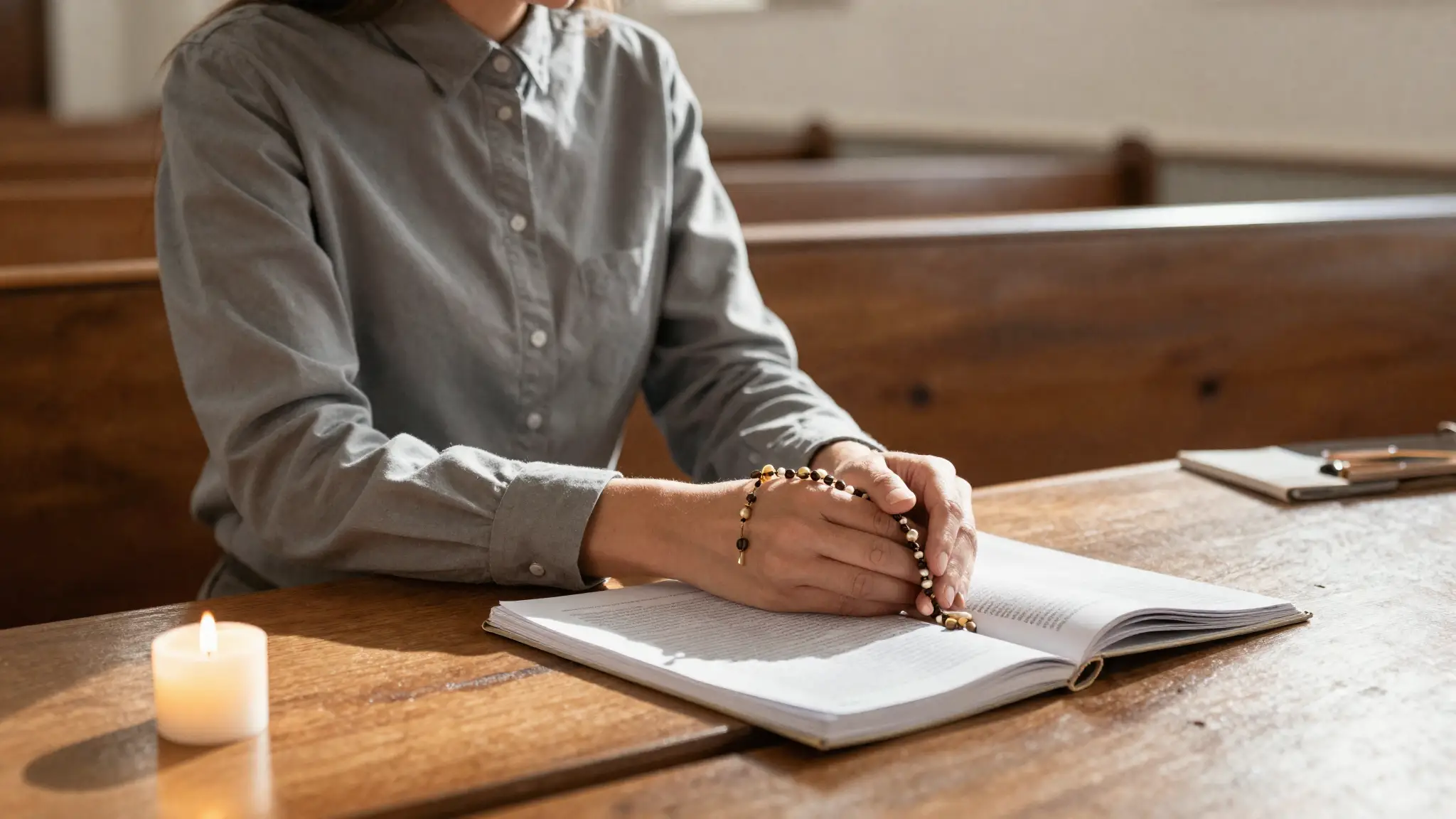
When you sit down to pray, you may feel stuck and unsure what to say. Starting can feel burdensome when prayer seems as though it must be long or eloquent. The Catholic Church recommends prayer at regular times, but it does not require a beginner to fill a long period. You can begin by setting one short sentence as your daily prayer time.
Key point Rather than measuring prayer by length or eloquence, begin with a short time attached to a repeated part of the day and practise returning to it.
What to remember
- Setting one fixed time and place helps you not to forget prayer.
- You begin the day by offering it in one short sentence each morning.
- Keep familiar prayers and a time of silence together, so you have something to lean on when words do not come.
Set a time and place first
Interpretation and application
The reason prayer fails to continue is usually not a lack of heart but a lack of place. If you attach it to a repeated moment every day, such as just after waking or before sleeping, it continues naturally without separate effort.
Choose one place as well. Whether it is a dining-chair or a place by the window, your body will learn to remember that seat as prayer time.
The Church describes the place of vocal prayer
Catechism paragraph 2157 says Christians begin their day and their prayers with the Sign of the Cross.
Paragraphs 2700–2704 describe vocal prayer as essential to Christian life and present the Lord's Prayer as the most perfect prayer.
Evidence for this claim: Catechism 2157: beginning the day and prayer with the Sign of the Cross · Catechism 2700–2704: vocal prayer and the Lord’s Prayer
Make room for silence, not only words
Catechism paragraph 2716 describes contemplative prayer as attentiveness that hears the Word of God.
Paragraph 2717 describes the silence of contemplative prayer as wordless love.
Evidence for this claim: Catechism 2716–2717: attentiveness to the Word and silence
If you miss a day, start again
Interpretation and application
You do not need to treat several missed days as failure. Rather than overcompensating, return today at the time you chose and begin with one sentence.
Personal prayer is not the same as Mass or the sacraments. A brief personal prayer does not replace the Church’s liturgy or sacramental life; follow your parish’s official guidance for participation.
Notes
- This is a practical introduction to brief personal prayer; it does not replace teaching on liturgy, sacraments, or doctrine.
- For decisions about forms of prayer or faith practice, also check the official guidance of your parish and pastoral minister.
Official sources
- Checked
- 2026-08-05
- Content responsibility
- Bookclip Catholic checked the correspondence between the public Catechism and this article.
- Limitations
- This is a general introduction to personal prayer. Official Church and parish guidance takes priority for liturgy, sacraments, and doctrine.